
Self-host SearXNG
Your own private search engine, with a JSON API for scripts and agents.
Shelley handles the setup. About 5 minutes.
Prefer a terminal?
curl -fsSL https://exe-staging.dev/deploy/searxng/prompt.txt | ssh exe.dev new --prompt=/dev/stdinSearXNG is a metasearch engine: it sends your query to Google, Bing, Brave, Wikipedia and dozens of other engines, merges what comes back, and shows you the results without ads, tracking or a profile of you. The engines see your server, not your browser.
On exe.dev it runs on a VM of your own, and it's private from the start: exe.dev's login stands in front of it, so nobody else can use up your engines' patience, and SearXNG's own bot protection can stay off. Make it your browser's default search engine, share it with your team, call its JSON API from scripts and agents with a VM token, and give Open WebUI or LibreChat web search without a paid search API.
What you get#
- SearXNG at your VM's private URL, behind exe.dev login, starting again after a reboot.
- Google, Bing, Brave and Wikipedia results, with engines that refuse cloud servers turned off.
- A JSON API at /search?format=json for scripts, agents, Open WebUI and LibreChat.
- Settings and the secret key in two small files, with a backup command you've checked.
What's running, and where
https://my-searxng.exe.xyz/
Search in your browser, signed in with exe.dev
https://my-searxng.exe.xyz/search?q=hello&format=json
The JSON API, for scripts and agents with a VM token
https://my-searxng.exe.xyz/
People you share the VM with, each with their own preferences
Deploy with Shelley#
Click Deploy and Shelley will set up SearXNG on a new VM, then check that it works. No config-file wrangling required.
Prefer a terminal?
curl -fsSL \
  https://exe-staging.dev/deploy/searxng/prompt.txt \
  | ssh exe.dev new --prompt=/dev/stdin
What Shelley is told
Set up SearXNG on this VM by following the exe.dev recipe at https://exe-staging.dev/deploy/searxng.md?via=deploy from top to bottom.

The recipe's example VM name is my-searxng. This VM's name is the output of `hostname`: use it wherever the recipe writes my-searxng. Skip the step that creates the VM; you are on it.

You are done when all of these are true. Check each one yourself:
- SearXNG at your VM's private URL, behind exe.dev login, starting again after a reboot.
- Google, Bing, Brave and Wikipedia results, with engines that refuse cloud servers turned off.
- A JSON API at /search?format=json for scripts, agents, Open WebUI and LibreChat.
- Settings and the secret key in two small files, with a backup command you've checked.

Read the whole recipe, including the closed details. For initial setup,
follow "Install by hand" first, skipping VM creation and SSH: Docker,
.env, settings.yml, the Compose stack, the search check and the backup
check. Skip the 401 check that says "On your computer"; the VM can't
reach its own public address. The walkthrough at the top is for the
owner afterwards.
Work as exedev in ~/searxng. Never overwrite an existing .env.
Use the owner's email from the reflection integration for
SEARXNG_CONTACT_URL; if it prints nothing, use the VM's own URL.
Don't share the VM, make it public, or turn on the limiter. Don't create
VM tokens (only the owner can, on their computer). Keep test searches to
a handful. Verify docker.service is enabled and the container uses
unless-stopped; do not reboot. Do not run Restore or Update.
Finish with the VM's URL and point the owner to "Make it your browser's
search engine" and "Use the JSON API".

Finish with the URLs I should open.
Also at /deploy/searxng/prompt.txt. The recipe it follows is /deploy/searxng.md.
Search#
Open your VM's URL, like https://my-searxng.exe.xyz/, and sign in to
exe.dev if you're asked. Type a query. Results come from several engines
at once, and each result says which engines found it.
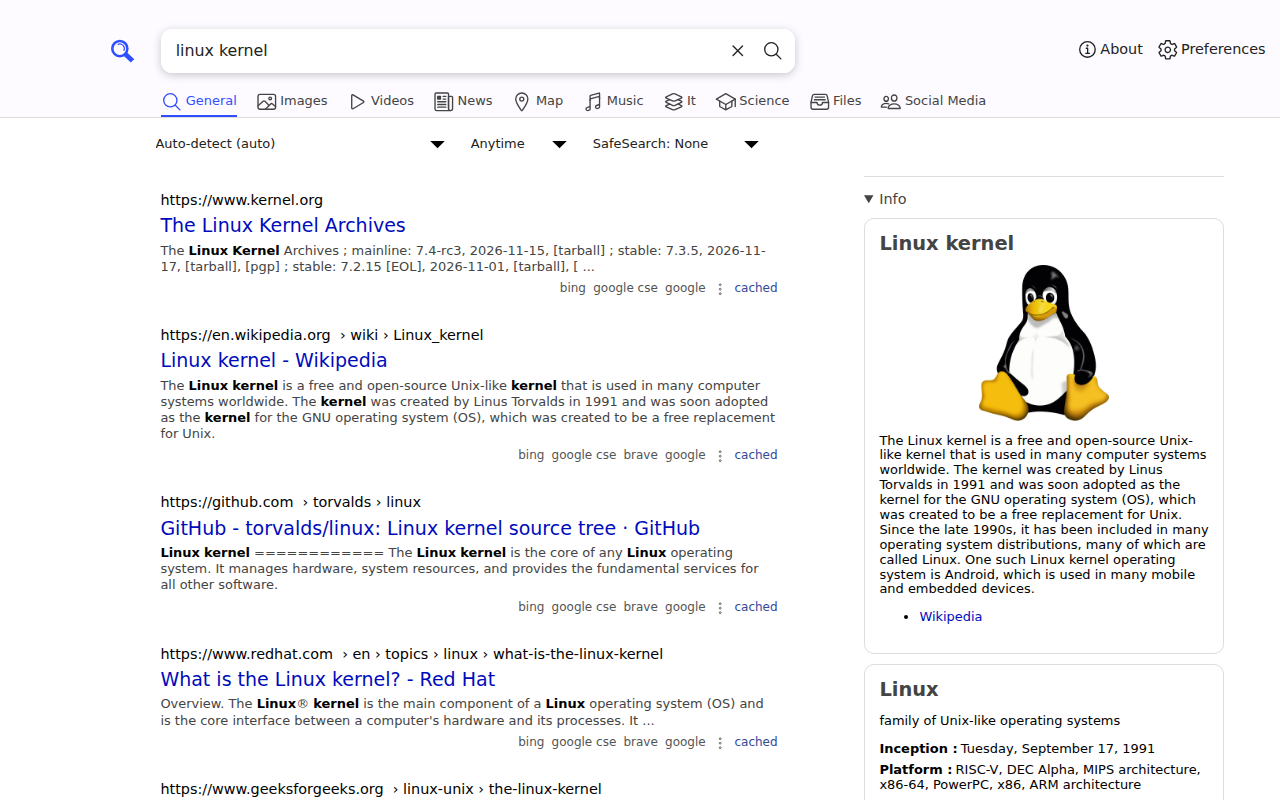
A few things worth knowing:
- Bangs pick engines for one search:
!goGoogle,!brBrave,!biBing,!wpWikipedia,!ghGitHub,!stStack Overflow.!images,!newsand!itswitch category. - Preferences (top right) set your language, safe search, theme and engines. They live in a cookie in your browser, so everyone who uses the instance keeps their own.
/statsshows each engine's response times and errors on your VM.
Make it your browser's search engine#
Use this address, with %s where the query goes:
https://my-searxng.exe.xyz/search?q=%s
- Chrome, Edge, Brave: Settings → Search engine → Manage search
engines and site search → Site search → Add. Give it a name and a
shortcut (
sx), paste the address, then choose Make default from its ⋮ menu. - Firefox (140 and later): Settings → Search → Search Shortcuts → Add, paste the address, then pick SearXNG as Default Search Engine at the top of the same page.
Your browser is signed in to exe.dev, so it sends the login cookie with
each search and results appear at once. When the exe.dev session runs out,
the search goes through the login page and then on to your results. The
address bar's suggestions come from /autocompleter on the same VM and
need the same cookie; if your browser doesn't send it for suggestions,
you'll just get no suggestions, and searching still works.
Use the JSON API#
The setup turns on SearXNG's JSON output, so any program can search:
/search?q=<query>&format=json returns the results, answers, suggestions
and any engines that failed.
The VM is private, so a program needs a token. On your computer, make a VM token that opens only this VM:
ssh exe.dev ssh-key generate-api-key --vm=my-searxng --label=searxng-api
It prints the token. Keep it where your scripts can read it, such as a
file with mode 600, and send it in the X-Exedev-Authorization header:
TOKEN=$(cat ~/.config/searxng-token)
curl -s -G https://my-searxng.exe.xyz/search \
  -H "X-Exedev-Authorization: Bearer $TOKEN" \
  --data-urlencode 'q=postgres vacuum full' -d format=json \
  | jq -r '.results[:5][] | "\(.title)\n  \(.url)"'
exe.dev checks the token and strips it before the request reaches
SearXNG. Without a token, or with a wrong one, the answer is 401. Tools
that only do Basic auth can send the token as the password, with any user
name. To revoke it, run ssh exe.dev ssh-key remove searxng-api.
Useful parameters: categories=news (or images, it, science),
engines=google,brave, language=en, time_range=day|month|year,
pageno=2 and safesearch=0|1|2. See SearXNG's
Search API.
On the VM itself, programs need no token: Shelley, Claude Code, or a
cron job can call http://localhost:8000/search?q=...&format=json.
Tip
For an agent or app on another of your VMs, make a VM-to-VM integration instead of copying a token. On your computer:
ssh exe.dev integrations add http-proxy --name searxng --target https://my-searxng.exe.xyz/ --peer --attach vm:my-agent-vm. The other VM then searches athttps://searxng.int.exe.xyz/search?q=...&format=json, and exe.dev adds the credentials on the way out, so there's no token on that VM to leak.
Web search for Open WebUI and LibreChat#
Both chat apps can use SearXNG as their search engine. Run them on their own VMs, give them a VM-to-VM integration to this one as in the tip above, and point them at the integration's address:
- Open WebUI: in Settings → Admin → Web
Search, choose
searxngas the engine and set the query URL tohttps://searxng.int.exe.xyz/search. Or setWEB_SEARCH_ENGINE: searxngandSEARXNG_QUERY_URL: https://searxng.int.exe.xyz/searchin its Compose file. Open WebUI addsformat=jsonand the query itself. - LibreChat: in
librechat.yaml, underwebSearch, setsearchProvider: searxngandsearxngInstanceUrl: https://searxng.int.exe.xyz. Integration addresses resolve to a link-local address, which LibreChat's SSRF guard blocks until you addallowedAddresses: ["searxng.int.exe.xyz:443"]towebSearch. LibreChat also needs a page scraper, such as a self-hosted Firecrawl, and a reranker (rerankerType: noneskips it). Its web search guide covers the rest.
A self-hosted Firecrawl can search through it as well: set
SEARXNG_ENDPOINT=https://searxng.int.exe.xyz in Firecrawl's .env, and
its /search endpoint returns this instance's results.
Choose engines#
The setup's ~/searxng/config/settings.yml keeps SearXNG's defaults and
changes only a few lines. Its engine choices come from testing on an
exe.dev VM in November 2026:
| Engine | From an exe.dev VM | In this setup |
|---|---|---|
| Google CSE, Bing, Brave | Answered | On |
Answered, with an occasional 403 |
On; SearXNG pauses it for 3 minutes after a refusal | |
| Wikipedia, Wikidata | Answered | On (they need the contact address in .env) |
| Yahoo, Mwmbl, Yandex | Answered | Off; turn on in Preferences or settings.yml |
| DuckDuckGo | CAPTCHA | Off |
| Qwant | Access denied | Off (SearXNG's default) |
Engines change their minds about cloud servers, so check /stats now and
then. To change an engine for everyone, add or edit its entry under
engines: in settings.yml, using the name shown in Preferences, then
restart. On the VM:
cd ~/searxng
sudo nano config/settings.yml     # e.g. add "- name: yahoo" with "disabled: false"
docker compose restart
Engines that need an API key (Kagi, Exa, Jina and others) are listed in SearXNG's engine docs.
Share it#
On your computer:
ssh exe.dev share add my-searxng teammate@example.com
They sign in to exe.dev and search at the same address, with their own
preferences. ssh exe.dev share add my-searxng team shares it with your
whole exe.dev team. Everyone's searches go out from the same VM, so a
large team can trip engines' rate limits sooner.
Use it responsibly#
SearXNG is polite by design: it sends one request per engine per search, suspends an engine for a while when it answers with an error or CAPTCHA, and tells Wikipedia and OpenStreetMap who to contact, as their policies ask. Keep scripted searches modest: a few per minute is fine; thousands an hour will get the VM blocked. For bulk crawling, use the engines' paid APIs. Search results belong to the engines that produced them, so check their terms before you publish or resell them.
Keep your settings#
Everything worth keeping is two small files: ~/searxng/.env (the secret
key and addresses) and ~/searxng/config/settings.yml. Back them up after
you change something; on the VM:
cd ~/searxng && tar -czf ~/searxng-backup-$(date +%Y%m%d).tar.gz .env compose.yaml config/settings.yml
On your computer, copy the archive off the VM:
scp 'my-searxng.exe.xyz:searxng-backup-*.tar.gz' .. For the whole disk,
see VM backups.
The nuts and bolts#
Happy clicking Deploy? You can stop here. These are the same setup steps Shelley follows, plus the maintenance commands for later.
Install by hand
Create a VM#
On your computer (pick another name if my-searxng is taken):
ssh exe.dev new --name=my-searxng
ssh my-searxng.exe.xyz
All remaining installation commands run on the VM, as exedev.
They use hostname, so your VM can have any name.
Get Docker ready#
SearXNG's recommended install is its container image. Enable Docker at boot, or exe.dev's on-demand Docker won't restart SearXNG after a reboot:
sudo systemctl enable --now docker.service
systemctl is-enabled docker.service
It should print enabled.
Write the settings#
.env holds what's specific to this VM, written once: a secret key
for SearXNG's signed cookies and image proxy, the public address SearXNG
puts in its links, and a contact address that Wikipedia, Wikidata and
OpenStreetMap require of SearXNG instances (they refuse to load without
one). The contact is your exe.dev email; SearXNG sends it to those
services in its User-Agent, nowhere else. Use any other address or URL you
prefer.
mkdir -p ~/searxng/config && cd ~/searxng
if [ ! -e .env ]; then
  contact=$(curl -fsS https://reflection.int.exe.xyz/email | jq -r '.email // empty')
  touch .env && chmod 600 .env
  cat >> .env <<EOF
# SearXNG reads these over settings.yml. Keep this file private.
SEARXNG_SECRET=$(openssl rand -hex 32)
SEARXNG_BASE_URL=https://$(hostname).exe.xyz/
SEARXNG_CONTACT_URL=${contact:+mailto:$contact}
EOF
fi
grep -E '^SEARXNG_(BASE|CONTACT)_URL=' .env
Expect your VM's address and mailto: with your email. If the contact is
empty, set it to something people can reach you at, such as
SEARXNG_CONTACT_URL=https://my-searxng.exe.xyz/.
settings.yml starts from SearXNG's defaults (use_default_settings) and
changes only what this setup needs. SearXNG's container takes ownership of
config/ when it starts, so write and edit these files with sudo:
sudo tee ~/searxng/config/settings.yml >/dev/null <<'EOF'
# Only what differs from SearXNG's defaults:
# https://docs.searxng.org/admin/settings/
# The secret key and addresses are in ../.env.
use_default_settings: true

server:
  # exe.dev login guards the whole site, so SearXNG's bot protection stays
  # off; it would also refuse curl and other scripts. Turn it on before
  # making the VM public.
  limiter: false
  public_instance: false
  # Load result images through the VM, not straight from your browser.
  image_proxy: true

search:
  # json and csv let scripts, agents, Open WebUI and LibreChat search.
  formats: [html, json, csv, rss]

engines:
  # These answer from exe.dev VMs.
  - name: google
    disabled: false
  - name: bing
    disabled: false
  - name: brave
    disabled: false
  # DuckDuckGo answers cloud servers with a CAPTCHA.
  - name: duckduckgo
    disabled: true
EOF
Start SearXNG#
This is SearXNG's official Compose template, trimmed to one service on port 8000, the port exe.dev's HTTPS proxy serves at your VM's address. SearXNG has no numbered releases; it publishes a dated image for every change, so pin one and move it forward when you update. The template's Valkey service is only for the limiter, which a private instance doesn't use.
cat > ~/searxng/compose.yaml <<'EOF'
name: searxng

services:
  searxng:
    # A dated build; see https://hub.docker.com/r/searxng/searxng/tags
    image: docker.io/searxng/searxng:2026.11.20-cd6d28091
    restart: unless-stopped
    ports:
      - "8000:8080"
    env_file: .env
    volumes:
      - ./config:/etc/searxng
      - ./cache:/var/cache/searxng
EOF
cd ~/searxng
docker compose up -d --quiet-pull
until curl -fs http://localhost:8000/healthz; do sleep 2; done; echo
docker compose ps
Expect OK and the container Up. The image is about 140 MB.
Check a search#
Ask SearXNG for JSON, the way a script or Open WebUI will:
curl -fsS 'http://localhost:8000/search?q=linux+kernel&format=json' \
  | jq -c '{results: (.results | length), engines: ([.results[].engines[]] | unique),
            infoboxes: [.infoboxes[].engine], failed: .unresponsive_engines}'
Expect a few dozen results from engines such as bing, brave and
google cse, infoboxes from wikipedia and wikidata, and a short or
empty failed list. An engine in failed with CAPTCHA or
access denied is refusing the VM; SearXNG pauses it and the others carry
on. If one keeps failing, turn it off as in Choose engines.
From outside, the VM is private. On your computer, this should print 401:
curl -s -o /dev/null -w '%{http_code}\n' 'https://my-searxng.exe.xyz/search?q=test&format=json'
Check the backup#
Make a backup and read it back:
cd ~/searxng && tar -czf ~/searxng-backup-$(date +%Y%m%d).tar.gz .env compose.yaml config/settings.yml
tar -tzf ~/searxng-backup-$(date +%Y%m%d).tar.gz
It should list the three files. Open https://<your-vm>.exe.xyz/ in
your browser and search.
Open it to the public
A public SearXNG gets found by bots within days, and once engines see a
flood of searches from your VM they block it for everyone. If you open it
anyway, turn on SearXNG's limiter first. It needs Valkey, and it has to
know which address in X-Forwarded-For is the visitor's: exe.dev's proxy
adds the visitor's address last, and Docker hands the request to SearXNG
from its network gateway, which limiter.toml marks as trusted.
The limiter refuses requests that don't look like a browser, so turn off the JSON API at the same time: public JSON endpoints are what bots look for. On the VM:
cd ~/searxng
sudo tee config/limiter.toml >/dev/null <<'EOF'
[botdetection]
# Docker's networks, where requests from exe.dev's proxy arrive from.
trusted_proxies = ['127.0.0.0/8', '::1', '172.16.0.0/12']

[botdetection.ip_limit]
link_token = true
EOF
sudo sed -i 's/^  limiter: false/  limiter: true/; s/^  public_instance: false/  public_instance: true/; s/^  formats: .*/  formats: [html]/' config/settings.yml
grep -q '^SEARXNG_VALKEY_URL=' .env || echo 'SEARXNG_VALKEY_URL=valkey://valkey:6379/0' >> .env
cat >> compose.yaml <<'EOF'

  valkey:
    image: docker.io/valkey/valkey:9-alpine
    command: valkey-server --save 300 1 --save 60 1000 --loglevel warning
    restart: unless-stopped
    volumes:
      - ./valkey:/data
EOF
docker compose up -d --quiet-pull
docker compose logs --tail=20 searxng | grep -i -E 'limiter|valkey' || true
Then, on your computer:
ssh exe.dev share set-public my-searxng
ssh exe.dev share set-private my-searxng closes it again. Remember to
add json back to formats if you go back to private and want the API.
Back up and restore
The backup in Keep your settings holds everything:
.env, compose.yaml and settings.yml. cache/ holds only website
icons, which SearXNG fetches again.
To restore on a new VM, run Get Docker ready above, copy the archive to the VM, and on the VM:
mkdir -p ~/searxng && cd ~/searxng
tar -xzf ~/searxng-backup-YYYYMMDD.tar.gz
chmod 600 .env
sed -i "s|^SEARXNG_BASE_URL=.*|SEARXNG_BASE_URL=https://$(hostname).exe.xyz/|" .env
docker compose up -d --quiet-pull
until curl -fs http://localhost:8000/healthz; do sleep 2; done; echo
The sed line points SearXNG's links at the new VM's address. Users'
preferences live in their browsers, so they carry over on their own.
Update
SearXNG changes often, mostly to keep up with engines that change their
pages, so update every few weeks. Pick the newest tag from
Docker Hub (the form is
YYYY.M.D-commit) and set it in compose.yaml. On the VM:
cd ~/searxng
tag=$(curl -fsS 'https://hub.docker.com/v2/repositories/searxng/searxng/tags?page_size=10' \
  | jq -r '[.results[].name | select(test("^[0-9]{4}\\."))][0]')
echo "$tag"
sed -i "s|searxng/searxng:.*|searxng/searxng:$tag|" compose.yaml
docker compose up -d --quiet-pull
until curl -fs http://localhost:8000/healthz; do sleep 2; done; echo
docker compose logs --tail=30 searxng
Then run a search. The logs list any engine that failed to load. If a new
build misbehaves, put the old tag back and run docker compose up -d.
SearXNG's changelog
is its commit log.
Troubleshooting
Start with the logs. On the VM:
cd ~/searxng
docker compose ps
docker compose logs --tail=50 searxng
- Few or no results: open
/stats, or look atunresponsive_enginesin a JSON search.CAPTCHA,access deniedortoo many requestsmeans that engine is refusing the VM; SearXNG pauses it for a while and the others carry on. Turn it off and another on. 403 Forbiddenfromformat=json:jsonis missing fromformatsinsettings.yml. Add it anddocker compose restart.wikipedia engine requires general.contact_urlin the logs:SEARXNG_CONTACT_URLin.envis empty. Set it and rundocker compose up -d.429 Too Many Requestsfor your own scripts: the limiter is on. A private instance doesn't need it; setlimiter: false.- Links or the search bar point at the wrong address: fix
SEARXNG_BASE_URLin.envand rundocker compose up -d. Permission deniededitingconfig/: the container owns it; usesudo nanoorsudo tee.ahmiaandtorchcan't register in the logs: those engines search Tor and need a Tor proxy. Ignore them.- Down after a reboot: run
sudo systemctl enable --now docker.service.
Frequently asked questions#
Is SearXNG free?
Yes. SearXNG is free software under the AGPL-3.0 and needs no API keys for its default engines. You pay only for your VM plan; it fits easily next to other apps on the default VM.
Does SearXNG keep my searches private?
It doesn't log queries or build a profile, and the engines see your VM's address instead of yours, with no cookies from you. They still see the words you search for. Your VM's outgoing address is shared with other exe.dev VMs, which helps hide you and also means engines treat it as a cloud server.
Can I make it my browser's default search engine while it's private?
Yes. A browser signed in to exe.dev sends its login cookie with every search, so results appear straight away. When that session ends, the search lands on exe.dev's login page first and continues to your results after you sign in. See Make it your browser's search engine.
Why do some engines return nothing?
Search engines guard against automated traffic from cloud servers. From exe.dev VMs, DuckDuckGo answers with a CAPTCHA and Qwant refuses, so this recipe turns them off and turns on Google, Bing and Brave, which answered. Preferences → Engines and the /stats page show what's working on your VM.
Can scripts and AI agents use it?
Yes, that's what the JSON API is for. Off the VM, send a VM token in the X-Exedev-Authorization header. On the VM, call http://localhost:8000. Another of your VMs can use a VM-to-VM integration, with no token at all.
Should I run a public SearXNG instance?
Probably not. Public instances attract bots, and engines then block the VM for everyone using it. Share the VM with the people who need it instead. If you do open it, turn on SearXNG's limiter first; see Open it to the public.
Published Nov 21, 2026 · Updated Nov 20, 2026 · tested end to end Nov 20, 2026 · Markdown · manifest.json · Something wrong? Tell us